BANK STATEMENT LIBRARY
Bank Statement Example: How to Read One
A bank statement example shows what a statement contains and where each figure sits, so you can read your own statement with confidence. This page walks through a sample statement section by section, checks its numbers, compares statements across countries, then links to 3 bank-specific layouts and to tools that turn a statement into a spreadsheet.
Bank statement example: the four sections every statement has
Banks lay statements out differently, but the same four parts appear on almost all of them. The header identifies the account and the period. The summary shows the opening balance, the money that came in, the money that went out, and the closing balance. The transaction table lists every posted item in date order. The footer carries fees, interest and notices. The sample below is illustrative: the figures are invented and the layout is generic, not copied from any bank.
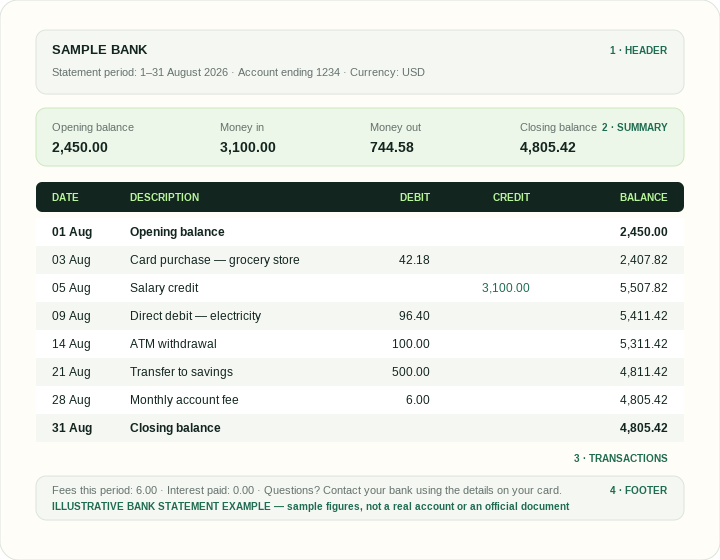
Sample bank statement layout, field by field
Use this table to locate each piece of information on your own statement. Labels vary by bank, but the meaning does not.
| Field | What it shows | Where it usually appears |
|---|---|---|
| Account holder and number | Name, address and a masked account number | Top of page one |
| Statement period | Start and end date the statement covers | Header, usually beside the account number |
| Opening balance | Balance carried forward from the previous statement | Summary box or first transaction line |
| Transactions | Date, description, debit or credit amount, and often a running balance | Main table on every page |
| Closing balance | Balance at the end of the period | Summary box or last transaction line |
| Fees and interest | Charges applied and interest earned or paid | Summary box or a separate section |
| Notices | Rate changes, terms updates, contact details | Footer or final page |
Reading the transaction table in a sample statement
Each line in the table is one posted transaction. The date is the posting date, which can be a day or two after the purchase. The description is whatever the merchant or the payment network supplied, so it may be a trading name rather than the shop name you remember. Debits reduce the balance and credits increase it; some banks print them in separate columns, others print a single signed amount. When a running balance column is present, each value is the balance immediately after that line posted.
Two checks confirm that a statement is complete. First, the opening balance plus all credits minus all debits should equal the closing balance. Second, the closing balance on one statement should match the opening balance on the next. If either check fails, a page is missing or a line has been misread. The same checks are what a converter uses to validate an extraction.
Checking the numbers in the sample statement
The sample above is small enough to check by hand, and doing it once makes every real statement easier. August opens at 2,450.00. One credit arrives, a salary of 3,100.00 on 5 August. Five debits leave: a 42.18 card purchase, a 96.40 electricity direct debit, a 100.00 cash withdrawal, a 500.00 transfer to savings and a 6.00 monthly fee, which add up to 744.58. So 2,450.00 plus 3,100.00 minus 744.58 gives 4,805.42, the closing balance printed in both the summary and the last line.
Read the rows for meaning as well as arithmetic. The transfer to savings is the largest debit, but the money is still the account holder's, so a budget should treat it as moving money, not spending. The 6.00 fee appears in the table and again in the footer, which is common: banks summarise charges separately so they are easy to find. And the running balance stays positive on every line, which tells you the account was never overdrawn during the month.
How bank statements differ by country
The four sections are universal; the details inside them are local. Dates, number formats, account identifiers and payment types change from one banking system to the next, and most misreadings of a foreign statement come from one of these four. The table summarises what to expect, and the bank pages below go into each system with a full specimen.
| Country | Dates | Amounts | Account identified by | Payment types you will see |
|---|---|---|---|---|
| United States | MM/DD/YYYY | 1,234.56 | Routing and account number | ACH, Zelle, checks, card |
| Canada | Month name or YYYY-MM-DD | 1,234.56 | Transit, institution and account | Interac e-Transfer, PAD, bill payment |
| United Kingdom | DD/MM/YYYY | 1,234.56 | Sort code and account number | Faster Payments, Direct Debit, standing order |
| Eurozone | DD/MM/YYYY | 1.234,56 | IBAN | SEPA transfer and direct debit |
| India | DD-MM-YYYY | 1,23,456.78 | Account number and IFSC | UPI, NEFT, IMPS, cheque |
| Australia | DD Mon YYYY | 1,234.56 CR | BSB and account number | BPAY, PayID and Osko, direct debit |
| Singapore, Malaysia | DD Mon or DD/MM | 1,234.56 | Account number | GIRO, FAST, PayNow, DuitNow |
Two conventions cause most errors. A date like 04/05 is April 5 in the United States and 4 May almost everywhere else, so establish the order from a day above 12 before reading anything. And in the eurozone the comma is the decimal mark, so 1.234,56 is just over one thousand two hundred, not one point two.
Bank statement examples by bank
Real statements differ in section order, terminology and the level of detail in descriptions. Each page below describes one bank's layout with an invented specimen statement, a walkthrough of its month, a field table and links to the bank's official download instructions. They are grouped by country so you can compare banks that share the same payment system.
United States
United Kingdom
Europe
Personal, business and credit card statements
A personal checking or current account statement is the layout shown above. A business account statement follows the same structure but usually carries more transactions, the company name instead of a person's, and sometimes separate sections for deposits, checks and electronic payments, each with a subtotal. Those subtotals are useful for checking the totals, but they are not transactions and should not be counted twice.
A credit card statement is different in kind. Instead of an opening and closing balance it shows a previous balance, new purchases, payments and credits, interest and fees, a new balance, a minimum payment and a due date. Purchases increase what you owe, so a card statement's debits and credits run the opposite way to a bank account's. Savings statements are the simplest: few transactions, interest credited, and sometimes an annual summary of interest for tax purposes.
How to get an official bank statement
Every bank offers statements in online banking and its app, usually under Statements or Documents, where you choose the account and the period and download a PDF. Most banks keep several years of statements online; older ones can usually be requested by phone or in a branch, sometimes for a fee. Many banks can also send paper statements by post. A statement downloaded this way is the authentic document a lender, landlord or accountant expects.
Do not confuse a statement with a transaction history. A history is a live list for any dates you choose; it can be printed or exported, but it has no fixed period and no opening and closing balance, and many organisations will not accept it in place of a statement.
Common mistakes when reading a bank statement
- Treating the app balance as the statement balance. The app is live and includes pending items; the statement is fixed at the period end.
- Looking for a purchase that has not posted. A card payment made on the last day often posts in the next period.
- Counting a reversed fee once. A fee and its refund appear as two rows that cancel; leave both in.
- Reading transfers as spending. Money moved to your own savings is not an expense.
- Misreading the date order. Check a day above 12 before assuming which number is the month.
- Ignoring the footer. Interest, fees and notices about rate changes often live there, not in the table.
What a sample statement is not
An example is a teaching aid. It is not a template for producing a statement, and it cannot be used as proof of address, proof of income or proof of funds. Only a statement issued by your bank, downloaded from online banking or the mobile app, is an authentic record. Anyone who asks you for a statement expects that document, not a reconstruction. If you need to understand what information a lender or landlord will see, the annotated sample above shows exactly that.
Official guidance on reading statements and disputing errors is published by consumer regulators; the Consumer Financial Protection Bureau's Ask CFPB resource is a good starting point for US accounts.
Turning a statement into a spreadsheet
Once you can read a statement, the next step is usually getting its transactions into a spreadsheet or accounting system. Upload the PDF to a converter, check the extracted rows against the opening and closing balance using the two checks above, and export. Keep the original PDF as the authoritative record; the spreadsheet is a working copy.
Bank statement example FAQ
Is a bank statement example the same as a template?
No. An example shows the layout and the kind of information a statement contains so you can read your own. It is not an editable document and must never be presented as a real statement.
What does every bank statement include?
The account holder and a masked account number, the statement period, an opening and closing balance, a dated list of transactions with descriptions and amounts, and any fees or interest for the period.
Why do the running balance and my banking app differ?
The statement shows the balance after each posted transaction as of the statement date. Pending card authorisations and transactions after the period end are not included.
Can I get a real statement from this site?
No. Authentic statements come only from your bank's online banking or app. The bank-specific pages below link to each bank's official instructions.
How do I turn a statement into a spreadsheet?
Upload the PDF to the bank statement to Excel or CSV converter, review the extracted rows against the opening and closing balance, and export.
How many months of statements do lenders usually ask for?
Commonly two to three recent months for a rental or loan application, and sometimes twelve for self-employed income. The lender's own checklist is the authority.
Is a transaction history the same as a statement?
No. A transaction history is a live list for any dates you pick; a statement is a fixed document for one period with opening and closing balances.
Why does my statement period not match the calendar month?
Many accounts close their cycle on a set day, such as the 14th. Every statement uses the same day, so periods never overlap or leave gaps.
Appendix: bank statement terms
The words below appear on statements from almost every bank. Each bank page adds the terms specific to that bank.
| Term | Meaning |
|---|---|
| Statement period | The dates the statement covers, also called the cycle |
| Opening balance | The balance carried in from the previous statement |
| Closing balance | The balance when the period ended; it opens the next statement |
| Running balance | The balance printed after each transaction |
| Posting date | The date the bank applied a transaction, which can be after the purchase |
| Pending | An authorised transaction that has not posted and so is not on the statement |
| Available balance | What you can spend now; it allows for holds and is not printed as the statement balance |
| Debit and credit | Money out of and into the account; card statements reverse the sense |
| Direct debit | A collection the payee starts under your authority |
| Standing order | A fixed payment you instruct the bank to send |
| Overdraft | A negative balance, often shown with a minus sign or DR |
| Masked account number | An account number with most digits hidden, such as •••• 1234 |